»A backlog is just a list of untested hypotheses. The only acceptance criterion is business outcome«. Jeff Gothelf’s words sound so nice and wise. But how does it work in practice?
I work as a consultant at SVT with the services Svt.se and Svtplay.se. They’re well-visited websites with clear and measurable goals. The culture at SVTi (which develops SVT’s digital services) encourages personal responsibility, decentralised decisions in the teams, and mistakes as learning. So all the conditions are in place to work with learning rather than feature development. Check, check and check.
Building a data-driven culture
That’s what it’s all about. Learning fastest what creates value, rather than developing features and content with the shotgun method. In our fine team we try to always demo learning, and only learning. That is, insights, data from experiments and what we get out of our KPI follow-up.
The teams I used to work in demoed what we had developed. Lots of features and functions. It always felt nice to show what you’d toiled over. But it was the wrong focus. The wrong truths became established. That we had created value now that our features had shipped. We could create waste and get away with it. Not good when you work with valuable licence fee money.
The effect of only demoing learning showed after a while. The goals became shared between stakeholders and our team. Editors wanted to run their own A/B tests. Help reach the goals. People setting requirements wanted estimates of the expected effects of different ideas before they “ordered”.
We’re not big fans of dogmatic doctrines, processes or methods in the team. But we try to understand how we work. So we drew up a process.
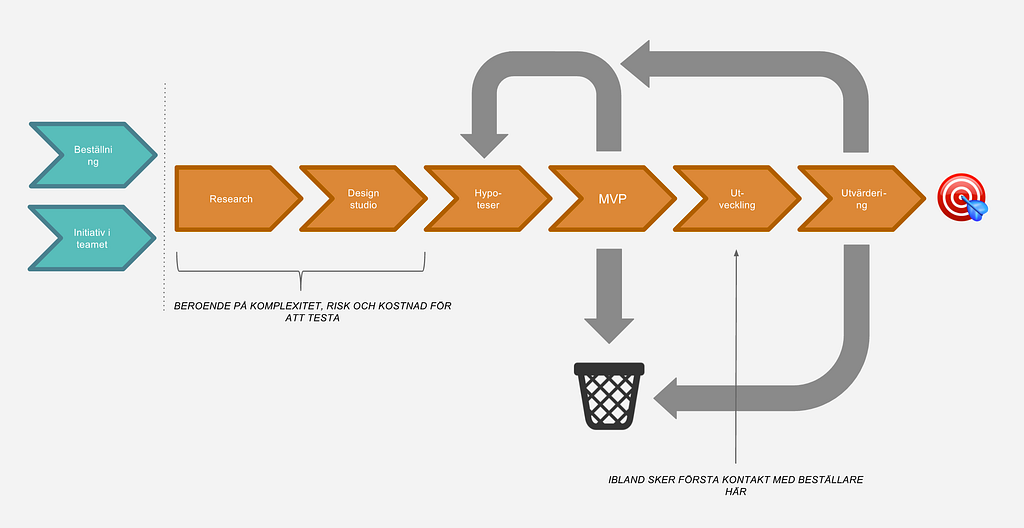
A model for how we work with requirements
1. Requests and initiatives
Requests come to the team. Ideally we want requests in an exploratory, Socratic style. Like: “Explore personalisation of recommendations in SVT Play”. Or “What happens if we move the TV schedule from Svt.se to Svtplay.se?”.
Requirements can also arise through initiatives in the team. Simply good ideas. Or results of hacks we do on the scheduled hack days we have.
2. Research
How much should you research a requirement? Hard question but simple answer. Enough that you can formulate sufficiently accurate hypotheses. Is the cost of validating the hypothesis high? Research more. Do you have the conditions to test hypotheses cheaply (recommended as a strategy)? Keep the research to a minimum.
We get a bigger request. The first thing we do is calculate the potential against the different services’ goals. Will the request help us reach our goals? We calculate and calculate through traditional web analytics. We have metrics on most things, down to the smallest detail. But there’s also valuable data we lack. For example, we can’t link total viewing time to adjustments we make to the interface.
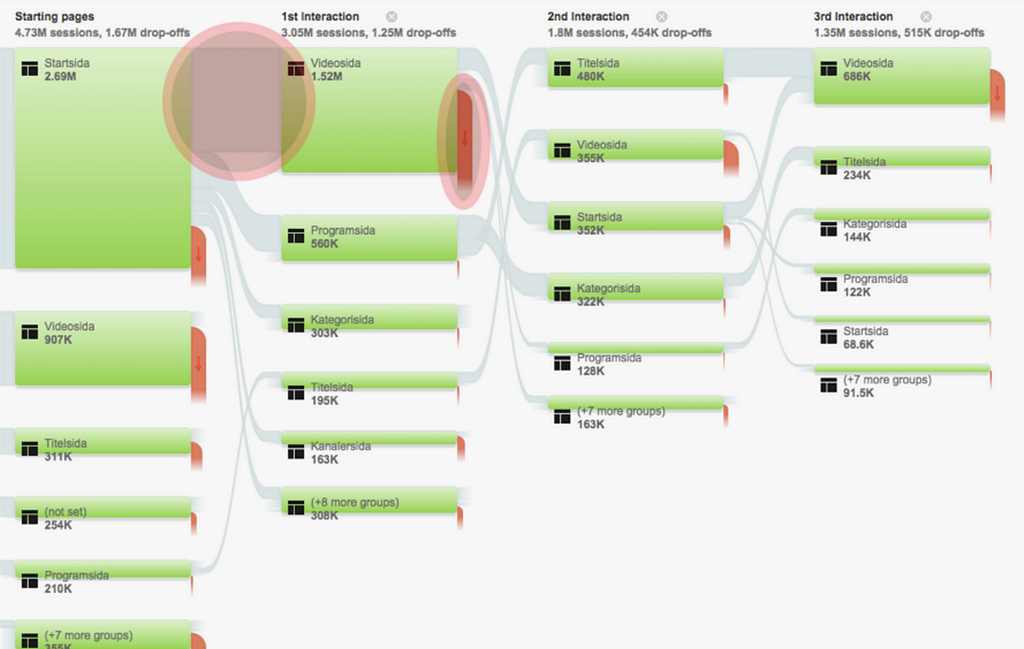
Example of a flow analysis of page types on Svtplay.se
We look at our metrics: history, seasonal variations and trends over time. Through monthly follow-up and all the A/B tests we run (perhaps 50 in the last year), we get a good estimate of how big the potential of the idea is. For example, moving the TV schedule from Svt.se to Svtplay.se. We have metrics on bounce rate, exits, conversions to Svtplay.se etc. We have metrics on visitor volume over time, and we can see on Google Trends how searches for “TV schedule” have developed over time.
In many cases we can already at this stage help those making requests understand how the request will affect our overall goals. Understand the potential in terms of visitor volume and goal fulfilment. Manage expectations of effects early.
3. Design studio
If needed, we run design studios. To capture views and solution ideas from all stakeholders and team members. To get the whole team to understand the big picture and which problem we want to solve; team alignment. Design studios can be well prepared or ad hoc depending on the problem’s complexity, risk and the cost of testing ideas.
There’s a lot that’s good about design studios. But sometimes it becomes a bit too much design by committee. No sharpness or edge in the proposed solutions. Smeared-out concepts without a clear direction. Sometimes it turns out really well. Perhaps the feedback culture in the group affects the result. If it’s good, the result is good.
4. Hypotheses
The output from the research and design studio work is hypotheses. A requirement has become a hypothesis. From here on we talk about hypotheses all the time. Never about requirements. “Hypotheses” put the focus on uncertainty that needs to be validated. “Requirements” put the focus on something established as good for the service and the users. And we don’t know that yet.
You can write hypotheses in all sorts of pedantic ways. We write them more or less however we like. Sometimes as requirements, sometimes a bit more structured with target audiences. The most important thing is including how the hypothesis is to be validated. Then you’re home and dry.
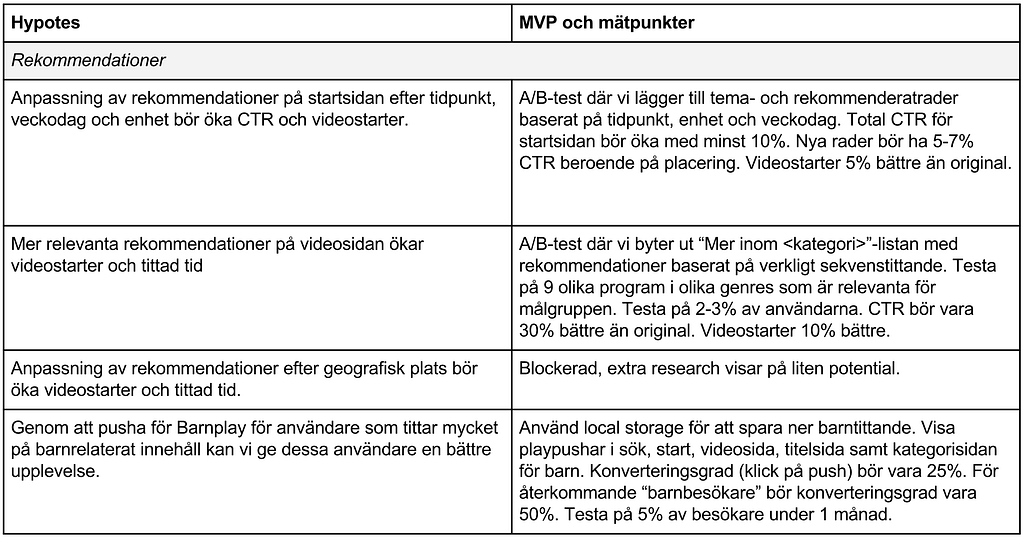
Example of hypotheses, MVP and metrics
5. MVP (minimum viable product)
In the team we discuss what is the absolute minimum we need to build to test the hypothesis. Often it becomes one or more dumb and quick experiments in the form of A/B tests. We hard-code a new recommendation row on the Svtplay.se start page at certain times relevant to the test. We add a semi-dynamic schedule element to the Svt.se start page.
In other cases we develop a more finished service that we A/B test. Sometimes on few users, sometimes on many. It depends on traffic volume and the risk that variants perform so badly that it affects the whole service’s goal fulfilment. We don’t want to risk the number of video starts dropping by several thousand because of validating a hypothesis.
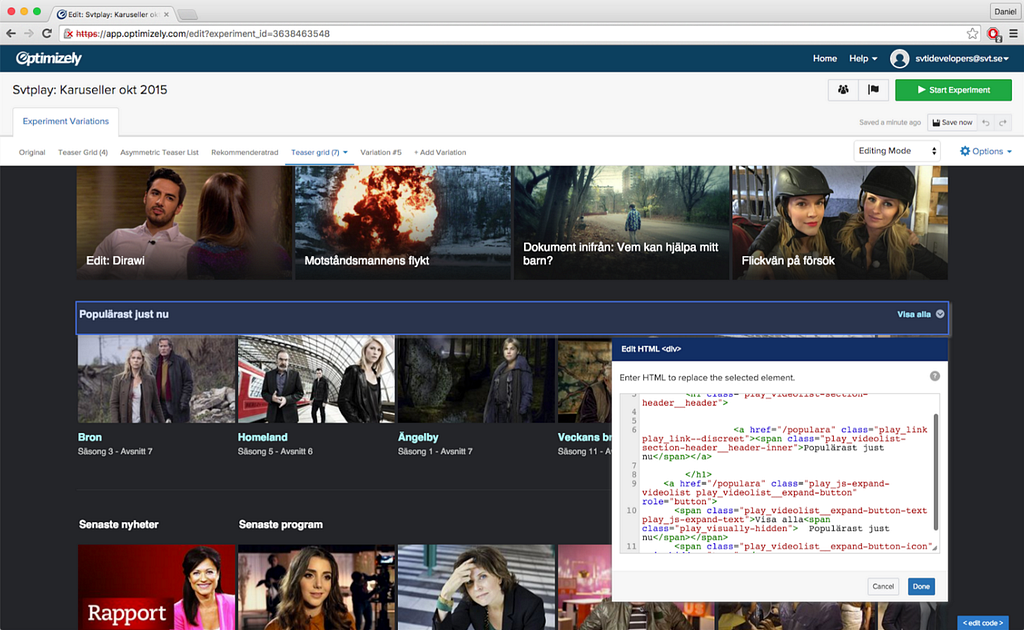
Example of a dumb A/B test in Optimizely that’s quick to produce
If we see potential after a completed A/B test, we almost always run a follow-up test. We want to reduce the risk that content, timing or other factors have affected the result. The same test again. Sometimes we see some potential and adjust the proposed solutions and test again. And then a follow-up test again.
This is the eye of the needle.
Hypotheses that have been validated move on to prioritisation. Hypotheses that haven’t been validated are thrown in the bin or rewritten. If those making requests want to go ahead with hypotheses that haven’t been validated, we make clear what the consequences will be. How it affects the service’s goals. The team makes it clear that from here on we take no responsibility for how this hypothesis affects goal fulfilment.
(I can’t stress enough how important it is to always include the service’s overall goals in A/B tests. We often see positive results in A/B tests at micro level, i.e. new content or functionality, while the overall goal has been affected negatively or not at all. Then it’s often about cannibalisation and the risk of sub-optimisation.)
6. Development
Regular, nice development and shipping.
7. Follow-up over time
You might think that through analysis and validation of hypotheses we have such high accuracy that we’re sure we’ve created value. But no. We need to follow up over time. You may have missed something; seasonal variations, content or something else may have had an effect. Something you hadn’t thought of.
We write down in our requirements tool how the hypothesis should be followed up. So that everyone can do it. Metrics and how to find the report.
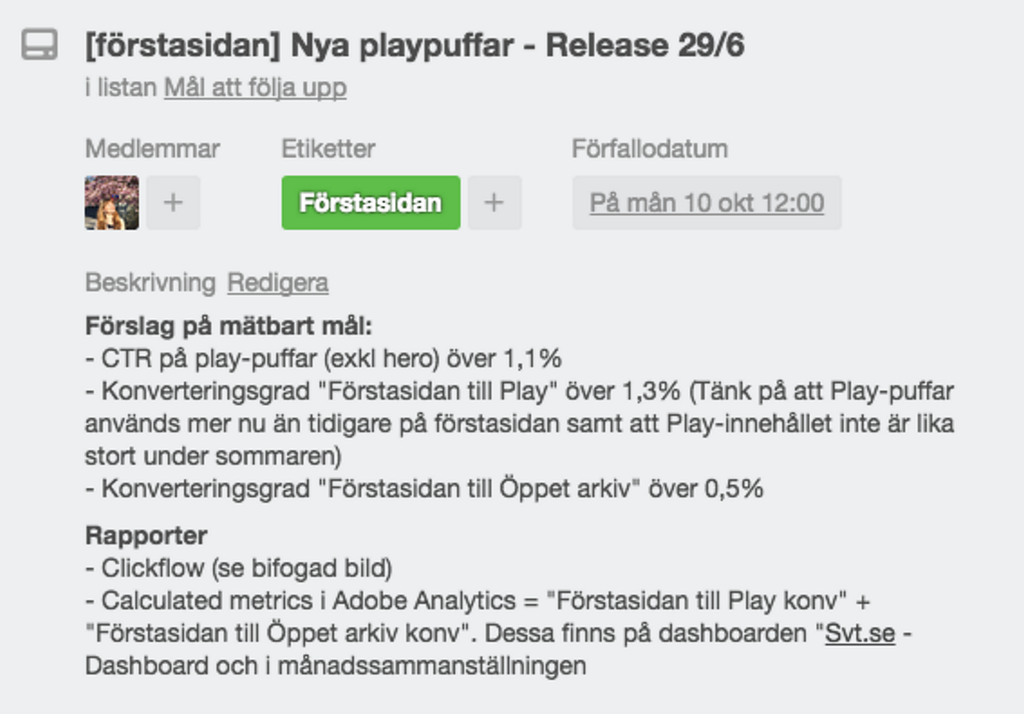
Write how hypotheses should be followed up in your requirements tool
KPI follow-up as a safety net
This process is somewhat simplified. But not much. We work with qualitative methods when needed. In the research phase if the complexity is high. If A/B tests show odd data, we may want to understand why. However, we never use qualitative methods like usability tests to validate hypotheses. That would be unprofessional.
Of course, we sometimes skip validating hypotheses. We just go for it. We do that for smaller requirements and when we know a lot about how the service will be affected by the requirement.
We have a gigantic (no joke) follow-up sheet where we follow up both KPIs and detailed metrics every month. It’s our safety net so that we don’t let through requirements that don’t create long-term value. The follow-up document means we’re ready to make tactical changes and reprioritisations.
This post was originally published on valtech.se on 17 August 2016.