
If you run usability tests to validate hypotheses, they are at best waste. At worst, you risk discarding fantastic ideas.
Let me make one thing clear before we start. Qualitative and quantitative methods both have their rightful places in the toolbox. Don’t stop doing usability tests.
In the late 90s, Rolf Molich (Jakob Nielsen’s friend) started his CUE series. CUE stands for Comparative Usability Evaluations. Nine teams were given the task of evaluating different websites. They could use any UX method they liked. Many chose usability tests, some chose expert reviews (sic).
After the second test, a surprising trend started to appear. The teams reported completely different UX problems
After the second test (CUE-2), a surprising trend started to appear. The teams reported completely different usability problems:
“The CUE-2 teams reported 310 different usability problems. The most frequently reported problem was reported by seven of the nine teams. Only six problems were reported by more than half of the teams, while 232 problems (75 percent) were reported only once.”
How serious the UX problems were also turned out to be highly subjective:
“Many of the problems that were classified as “serious” were only reported by a single team. Even the tasks used by most or all teams produced very different results — around 70 percent of the findings for each of these common tasks were unique.”
And so it continued. In CUE-4, when a hotel website was to be evaluated, 17 teams worked on UX evaluations. A total of 340 UX problems were reported. Only nine (!) of these were reported by more than half of the teams. When Molich answered a direct question, “How can teams be sure they are addressing the right UX problems?”, he made it clear:
“It’s very simple. They can’t be sure.”
What does this tell us? Usability tests are far from scientific. Their reliability is often below par. They are subjective and hard to carry out. But why is that?
- Tests are carried out on people who are not representative of the target audience
- The results have to be interpreted — subjective by nature
- Teams test their own design, which can steer both the outcome and the interpretation of the data
- Tests and interviews are carried out in an unrealistic environment. For example, detailed questions are asked about views the user only visits for a fraction of a second
- Too few people are tested to get statistical certainty in the validation itself
- When it comes to questions about requirements, users are often poor at analysing their (future) behaviour
Even if you do everything right, it goes wrong
You are going to “validate” your design or hypothesis. Say you do everything right. As scientifically as possible.
- You manage to find test participants who are representative of the target audience.
- You let another team test your design.
- You explain the context to them perfectly.
- They interpret the users’ behaviour spot on — seeing through interview answers in particular, but also behaviour that seems unrealistic for real situations.
- The users are as close to a “real” context as possible.
- They are not stressed by the situation.
- Test tasks and interview questions are realistic and do not disrupt the flow of use.
- Questions are not asked in unrealistic settings, such as asking a user to comment on a view they look at for a long time.
You do all of this right.
Even so, you will not be able to be sure whether a hypothesis holds or not. You are testing on too few users to be sure. The result is statistically insignificant anecdotes.
Even if you were to test on 20 users — which I have experienced once (1) in my twenty-year career in UX — you will have a margin of error of ±19% when you draw conclusions about the whole population. To get down to a ±10% margin of error (generally considered the absolute minimum in the industry — most go with ±5%) you need 71 users. Which becomes insanely expensive. It just doesn’t happen.
I am absolutely not saying you should stop doing usability tests. I mean that usability tests are a poor method for validating hypotheses. Usability tests are good at a lot. You can identify usability problems. You can discover problems with completely different things from what you are testing. You can understand behaviour when you interpret data professionally. You can get really good ideas for hypotheses. And it is fairly cheap. But — and this is important — you cannot see how widespread a problem is. Or whether a hypothesis holds. Whether your observations apply to everyone.
As someone wrote:
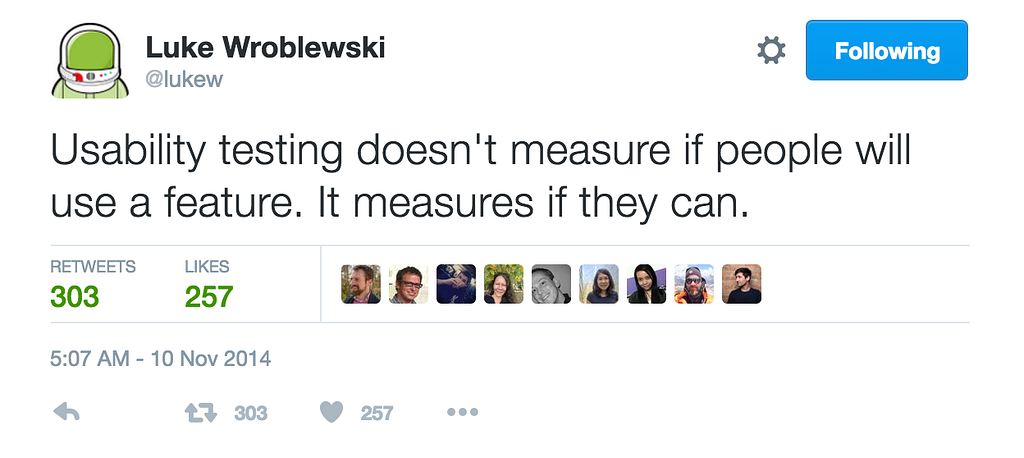
With usability tests you risk discarding good ideas
I don’t know how many times a hypothesis I have sent for usability testing has been reported as “the users didn’t seem to like the solution” by the test leader in charge. I have had to nag to get the hypothesis A/B tested. In many cases running my own tests under the radar. And data from these A/B tests — and follow-up tests — often shows completely different real usage from what came out of the usability tests.
You want to know whether your hypothesis holds or not. Take my recommendation. A/B test your hypothesis instead of usability testing it. But only if you have the opportunity. And by opportunity I mean:
- Metrics that are indisputable, not open to interpretation.
- Metrics that are easy to validate statistically in optimisation and analytics tools. Loyalty is an example of a metric that is hard to follow up in an A/B test.
- Enough traffic volume.
- A reasonable cost for running tests.
- Short or non-existent change curves (if you have long ones, you need to follow up over time to validate)
- Knowledge of A/B testing close at hand.
This is where I think many of us should strive to be as UXers. You fantastically creative and methodologically strong person who is already a whizz at usability tests and other qualitative methods. Understand the difference between anecdote and empirical evidence.
You have power, so use the right words
And please, please, with a cherry on top. Never generalise when you present qualitative data. Don’t say “the users” or “they” when you show your nice videos or your presentation (“They prefer this icon over that one” / The users understand that you can…”). What you say then risks being perceived as quantitatively proven truth. And even worse, of course, is establishing value judgements in your presentation of data: “How great that the users liked the new feature”.
Say this instead:
“This particular user (+ add any uncertainty in method and context, e.g. a stressed user) seems to like/use/dislike/not understand the content/functionality. That does not at all mean we know this is the case for our target audience. It means we may be on the trail of a problem/a solution. The question is whether enough people have the same problem/would behave the same way. What is the smallest thing we can build to find out, do you think?”
Are you running interviews or usability tests to explore motivations and behaviours? Make sure you also research (or validate with experiments) the market and potential linked to the motivation. User research and market research. Otherwise you risk creating fantastic solutions that no one uses. That is a waste of money. Public and private alike.
Strive for architecture, tools and a culture that make it easy and cheap to A/B test. Get this in place. Then use quantitative data as knowledge. Hug it tenderly. Become an even better designer and then save the world.
Until then, be very careful not to draw quantitative conclusions about a larger population than those who took part in the usability test.

Fluffy dog by y-a-n under CC BY-NC-ND 2.0
This post was originally published on valtech.se on 10 November 2016.