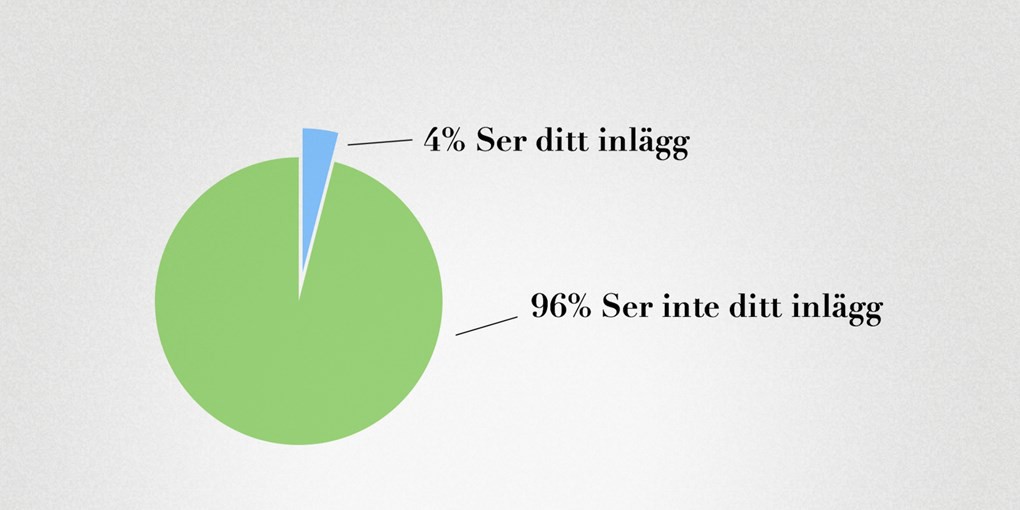
EdgeRank is the algorithm Facebook uses to work out which posts end up in your feed. Since there are thousands of posts with some relevance for each user, some mechanism has to filter out posts with low relevance. This is where EdgeRank kicks in.
An edge is an action a user takes. It could be, for example, posting a status update, liking a page, tagging a person or place, commenting on or liking a post. Or accepting an invitation to an event. All of this is called edges.
Every time you open Facebook, EdgeRank tries to work out which posts are most relevant to you right now. The post with the highest EdgeRank score is shown at the top, then the one with the second-highest score. And so on. It is said that more than 100,000 factors affect the relevance ranking.
Just as Google constantly adjusts its relevance ranking algorithm, Facebook does the same. However, three main factors have continued to affect the ranking since 2010:
- Affinity
- Edge weight
- Time decay
1. Affinity with the person who posted
Affinity means how strong the relationship is between a user and an edge. For example, if you write a lot on a friend’s wall, comment on their posts and have also tagged them as a family member, it is reasonable for the affinity score to be high.
To calculate a user’s affinity score with another person or page, Facebook looks at several factors. Among other things, how long ago you interacted, what type of interaction took place and how many mutual friends you have.
The more effort an interaction requires from you, the higher the affinity score. That is, writing posts on a friend’s wall or commenting on their posts gives a higher score than liking a status update.
The affinity score is adjusted over time. If you reduce your interaction with a person or page over time, the affinity score also decreases.
The affinity score is also usually higher early in the relationship; when you have just become friends with someone or started liking a page, status updates from them are shown more often, all else being equal. But if you don’t interact with these posts, the affinity score drops quickly.
It also seems that the affinity score is affected by how you became friends with someone or started liking a page. If you like a page via an ad, you get a lower affinity score. If a friend is recommended to you rather than you looking them up, you also get a lower affinity score from the start.
2. How the content is weighted
All the different interactions (“edges”) have different weights. Partly a general weighting where some interactions give higher scores; posting video or images, for example, gives a higher score than posting or sharing a link. But there is also a personal weighting where Facebook tries to understand which types of interactions you are most interested in. If you often click on images or comment on links, these types of edges will be ranked up.
Facebook also seems to take into account who is doing the interaction. If you often comment on your sister’s photos, your sister’s photos will be shown more often than her links. Until you change your behaviour.
When Facebook rolls out new functionality, these edges are initially given a higher weight to get users to try them. For example, videos have been shown disproportionately often in feeds over the past autumn and winter.
For link posts, Facebook looks at the quality of the source, what type of website it is and how often it has been shared, commented on and liked.
3. When the post was written
The more time that has passed since an interaction took place, the lower its time score. It is about filtering out news that has become old. The time factor also seems to be adjusted according to how long ago you last logged in and how often you generally use Facebook.
Criticism of EdgeRank
One criticism levelled at Facebook recently is that it gives new functionality too much weight. Facebook has shown figures of high video growth and that it now gets more video posts than YouTube from companies and organisations. But the growth is not due to “rich” interactions but to video being given a high weight. Which gives low relevance but good numbers.
“Story bumping” is often really annoying. It refers to posts that were originally shown in your feed but which you ignored due to low relevance. But because the post has since been shared so much, it has got a crazily high affinity score and makes a comeback in your feed.
Personally, I think Facebook has the biggest problem finding good relevance when it comes to time. Especially for users and pages that you have a high affinity with and that post often. Old news often pops up if you, for example, like a football club or a newspaper.
Other influences besides EdgeRank
“Last Actor” is a variable that looks at your last 50 actions. Posts that rank poorly according to EdgeRank can end up in the feed because they match what you have done recently. If you interact with these posts, they will keep being shown; otherwise they disappear.
“Story bumping”, see above.
The device you use and what connection you have affect which content is shown in your feed.
Posts that many users have flagged as spam are ranked down by Facebook.
Tips for ending up in users’ feeds
- Post content that gives a high weight. Images (but not decorative images) and native video before links and plain status updates. But vary the type of post. Use the Insights tab to follow up which types of posts give good reach and interactions.
- Always tag people, brands and places to increase the affinity score somewhat.
- All social interactions on your posts are important. But if there is one thing you should optimise for, it is shares of your post. They give up to four times as much weight as comments and likes. A common trick for getting comments is asking questions in status updates.
- Make sure you don’t post at the same time as your competitors. Then it becomes a battle for affinity scores that you have to win.
- Post often. The time factor means new posts constantly have to be published to fill your place in the feed. There are loads of tools for scheduling posts. Weekdays generally give better engagement than weekends, especially Thursdays and Fridays. Another interesting approach is to post when the majority of your target audience is offline. That is because the competition is also lower then.
- Avoid getting caught in Facebook’s spam filter. Don’t post links with obvious offers. A bad post that many users complain about can affect your chances of being seen in feeds for a while.
- Shorter posts seem to give slightly better engagement than longer ones.
This post was originally published on valtech.se on 8 January 2015