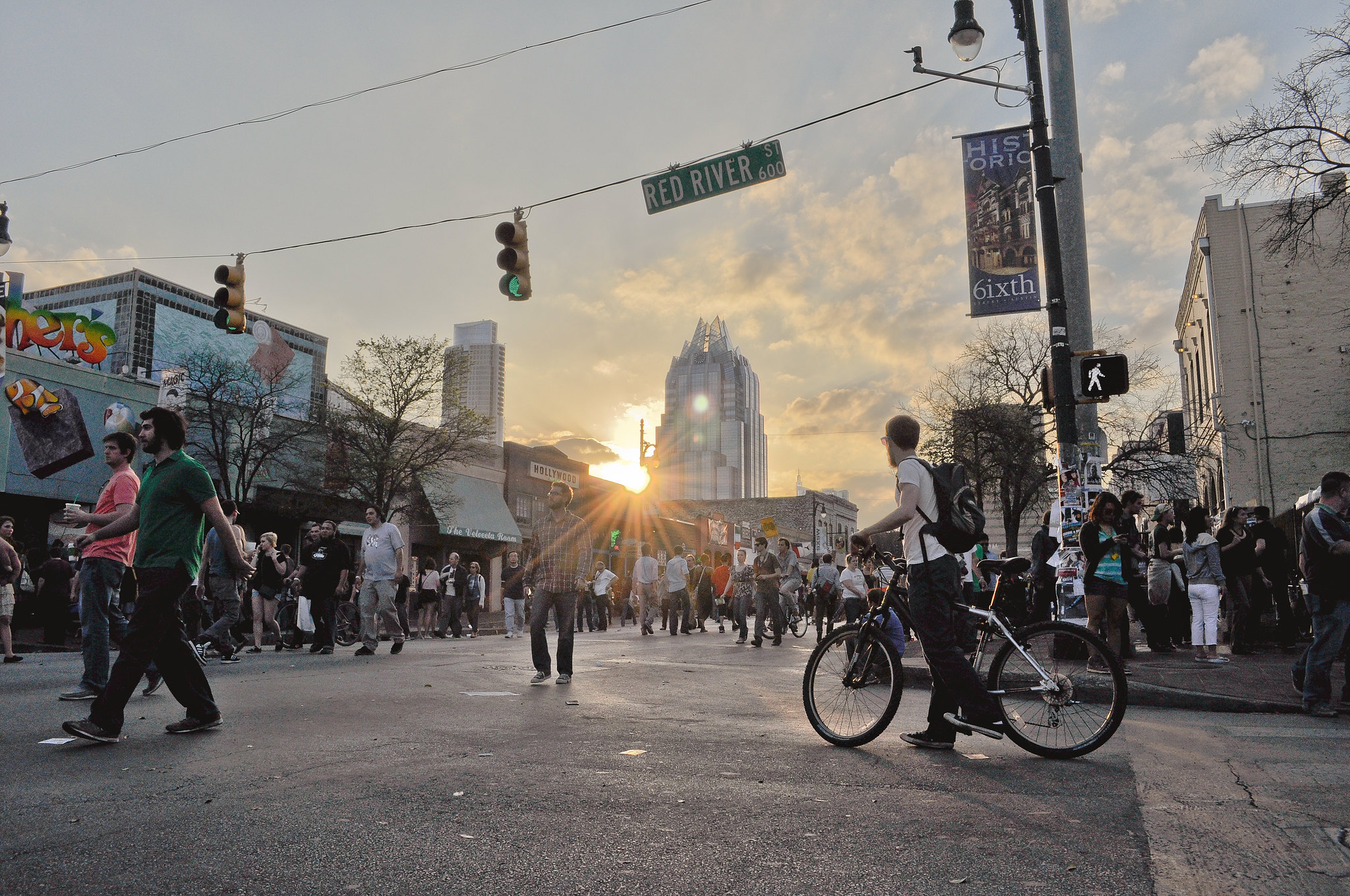
In five hours the SXSW festival begins. What has now become a monster — albeit a fantastic monster — started with a few hundred participants and a handful of panels at the Hyatt Austin in 1994. We remember three moments.
1995: Todd Rundgren kills the CD-ROM
It feels like an eternity ago, but the interactive part of SXSW had its roots in the Austin area’s CD-ROM scene. Yes, it doesn’t sound quite right. Everyone thought CD-ROM was the next big thing, and in many of the very first panels sat local multimedia producers making animated series and interactive games in Macromedia Director and scripting Lingo. For Apple!
And for a few years that’s exactly what it was. Hot. The panels had titles like “International Standards for Multimedia” and, a bit more progressively, “Net Surfing: Web Browsing”.
In 1995 Todd Rundgren was one of the keynote speakers. In what has been described as “a room full of people straight out of Revenge of the Nerds” — and in front of an audience that made its living creating content for exactly CD-ROMs — Todd said the CD-ROM was dead. Everything would move to the web. Music would be placed on servers. The CD-ROM era was over.
It went quiet. So quiet that the spring birds around Lady Bird Lake could be heard all the way to the Hyatt Austin. The twittering of a new era. And then nobody looked back.
2008: Mark Zuckerberg gets grilled
Somehow the organisation behind SXSW managed to lure Mark Zuckerberg to a keynote interview in 2008. Mark had never visited SXSW before. Hadn’t shown himself in front of those in the know. The kids. It was the first time the industry would get to know Mark, CEO of the most important company.
Completely packed. Thousands in Ballroom A. Crowds who couldn’t get in. Fans who want Facebook to work, to stop censoring posts and to make it easier to keep track of their privacy. Is Mark the right person to lead this project to the finish line? A college dropout?
Lots of questions and a rare chance to get answers to exactly these questions. House music pumped from the speakers and the people at the front danced on their chairs.
The interview was done by Sarah Lacy. The first 15 minutes were pure nonsense. The audience wanted answers to development questions while Lacy insisted on talking business. Lacy grilled Zuckerberg and tried to catch him out. Of course there were tough questions about privacy. The audience started turning against Zuckerberg. They didn’t like his attitude. Then it got weird.
People started shouting about asking real questions. They started booing and asking their own questions. Twitter went bananas. The people in the room were checking Twitter. Zuckerberg and Lacy weren’t following Twitter. In fact, it was Twitter that got the audience to turn against the people on stage. It was the first time in history that an audience organised itself through social media.
Conferences would never be the same again.
2010: The Great Check-in Smackdown
It was the year the epithet rock star was no longer reserved for actual rock stars. It was the year tech stars broke through with full force. It was the native son vs New York. It was art and elegance vs social geo-brilliance. And in the end it was about numbers to show VCs and the TechCrunch editorial team. Number of check-ins. It was Williams vs Crowley. Gowalla vs. Foursquare.
Actually, both services were launched, independently of each other, as early as SXSW 2009, and the big difference was that Foursquare had a social layer from the start, while Gowalla was more of a solo experience and sported clear game mechanics.
And while Gowalla was so furiously elegant, Foursquare struggled with grey icons and interaction design that would have fitted right in among the CD-ROM kids of 1994.
Along came SXSW 2010. Every self-respecting tech publication had covered the rivalry and wrongly described it as bitter. Declared that we were ready for a make-or-break moment. Foursquare painted its dodgeball court outside the Austin Convention Center and threw a hip-hop party — unusual for Austin. Gowalla countered with a legendary tiki party at The Belmont. And perhaps this is where it peaked. The great check-in smackdown.
It soon turned out that Foursquare’s social features — and the number of users — were far too strong for Gowalla. As someone wrote: “We used Foursquare all the time during SXSW. Where is everyone? The Driskill? Then we’ll head there. But so-and-so checked in over there. Then we’ll head there. It’s bound to be a better party!”. Nobody wondered which rare Gowalla items you’d picked up. Social eats gamification for breakfast.
Even though Gowalla won SXSW’s Best Mobile Website Award ahead of Foursquare, it had already lost.
It will never be over
In five hours SXSW begins again. Spring is creeping closer. The Lady Bird birds are finding their way up to our obscenely expensive rented house on Castle Hill. It’s time to get closer. To feel unbeatable. To love your profession, your industry and your colleagues.
SXSW, mon amour. For me, you will never be over.
This post was originally published on valtech.se on 7 March 2014